Experience this project by clicking here.
- Audience: Employees at a mid-sized organization, from frontline staff to executives
- Responsibilities: Instructional Design, eLearning Development, prompt writing
- Tools used: Claude AI
The Problem and the Solution
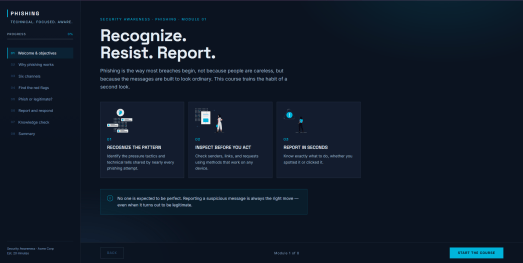
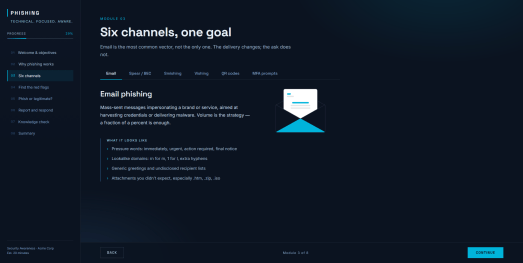
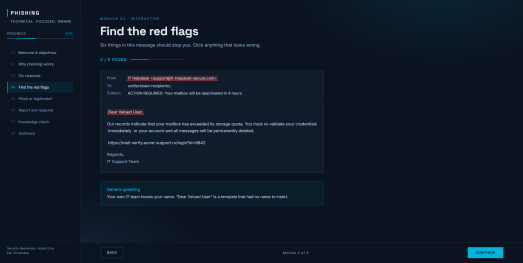
Phishing attacks are becoming harder to recognize as generative AI makes messages more polished, personalized, and convincing. Instead of focusing on spelling mistakes and other outdated warning signs, I designed this course around a more useful skill: evaluating the request. The course teaches learners to recognize common emotional tactics, identify phishing across different communication channels, and follow one simple behavior: pause, verify, and report.
The Process
I used Claude AI throughout the development process, from creating and refining prompts to guiding the course content, instructional approach, and visual design. Rather than simply generating content, I directed the AI toward specific learning goals, scenarios, tone, and design requirements, then reviewed and refined the results to make sure they supported the learning objectives.
This approach allowed me to use AI as a development partner while still applying my instructional design and eLearning development skills. I made the decisions about what learners needed to know, how they would practice it, and how the content should be presented.
The Results
The result is a fully interactive phishing awareness course that combines scenario-based learning, practical decision-making, and a modern visual design. The course demonstrates how AI can be used to support the development of an eLearning experience while still requiring instructional judgment, content review, and design direction throughout the process.
The final course gives learners a simple framework they can use when evaluating suspicious messages.
 Lauren Ackley